



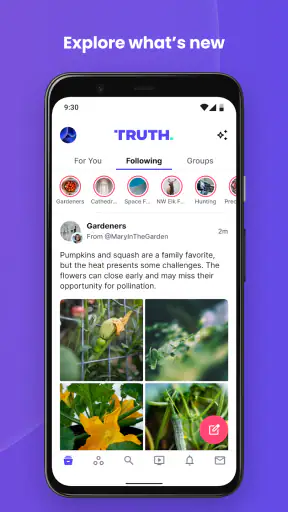






I approached Truth Social as a social app for people who want a different place to follow public conversations, publish their own thoughts, and keep up with accounts they choose. Its central appeal is easy to understand: it presents itself as a free-speech-focused network rather than another general-purpose feed. In daily use, though, the real question is less about the slogan and more about whether the conversations you want are active, readable, and worth returning to.
The app is free to use, belongs to the social category, and is developed by T Media Tech LLC. It carries a Teen content rating, so I would not treat it as a children’s social space. The current version is 1.27.4 and requires Android 10 or later. That combination makes it reasonably accessible on many recent phones, while still excluding older devices that may otherwise handle a lightweight social feed comfortably.
How Truth Social feels in a normal day
My baseline workflow with the app would be simple: open the feed, scan the newest posts, pause on anything genuinely useful, and avoid letting the stream decide the entire shape of the session. That last part matters. Like most social networks, Truth Social can turn a quick check into a much longer visit if I keep following replies and reacting to every new item.
The most practical starting point is to follow accounts that match a clear purpose. I would create a small mental list of people or organizations I actually want to hear from instead of treating every visible post as equally important. For example, someone might use the app to follow political commentators, local voices, independent publishers, or personalities they feel are underrepresented elsewhere. The experience becomes much easier to judge once the feed reflects a deliberate selection rather than a random first impression.
I also found that the app makes more sense when used as a conversation tracker rather than as a complete news source. A post can show what a person is saying, but it does not automatically provide context, verification, or a balanced account of an event. I would open a separate source when a claim affects a decision, especially around health, money, safety, or public affairs. That habit keeps the platform useful without asking it to do a job it was not designed to do.
For an everyday scenario, imagine checking the app during a commute. I would spend a few minutes scanning familiar accounts, save my attention for posts that contain a clear point, and leave before the feed becomes repetitive. Later, I might return to review replies to one discussion. This approach is more rewarding than endlessly refreshing because it gives the app a defined role in the day.
The interface is most valuable when I already know what I am looking for. If I arrive without any followed accounts or topic in mind, the service can feel less predictable than larger social networks with broader discovery systems. That is not automatically a weakness; a narrower network can feel calmer. It does mean that new users should expect to spend some time shaping their experience.
What the audience size tells me
Truth Social has passed the five-million-install mark and has an average rating of 3.0 from around twenty-eight thousand ratings, with roughly nine thousand six hundred written reviews. Those figures suggest meaningful interest, but also a mixed experience among users. I would read that as a reason to test the app personally rather than assume that its public profile guarantees a smooth fit.
The size of a social network affects more than popularity. It affects how quickly a post receives a response, how diverse the discussion feels, and whether a niche interest has enough people to remain active. Truth Social may be a strong match if the people you want to follow are present and posting regularly. If your friends, colleagues, or favorite communities are elsewhere, the app may feel quiet even when its overall audience is substantial.
Settings I would check before settling in
I would begin by reviewing notification controls. Social apps can become tiring when every interaction interrupts the day, and a free-speech-centered feed can contain especially active discussions. I prefer notifications that help me return to a conversation I intentionally started or followed, rather than alerts for every small change. The exact choices available can vary by device and app build, so I would inspect the controls directly instead of assuming the defaults are ideal.
Privacy and account controls deserve the same attention. Before posting, I would check who can see the account, how public activity feels, and which profile details are visible. A social post can travel farther than expected once other people react to it or repeat its wording. The safest workflow is to assume that anything shared publicly may be read outside the original conversation, even when the post felt casual at the time.
I would also review content and interaction preferences whenever the app presents them. The goal is not to remove every disagreement. It is to make the feed usable enough that I can distinguish an interesting argument from a stream of personal conflict. Muting or limiting unwanted conversations, where those controls are available, can be more useful than abandoning the service after one unpleasant exchange.
Another setting worth checking is the behavior of media and links. Social feeds can consume attention quickly when images, videos, or external pages appear constantly. If the app or the phone provides ways to reduce background activity or limit interruptions, I would use them for a more controlled routine. This is especially helpful for people who want Truth Social as an occasional check-in rather than their primary source of entertainment.
Sign-in security is easy to overlook. I would use a password that is not shared with another service and keep recovery details current. That is ordinary advice, but it matters more on a platform where a profile may represent personal opinions, public work, or a recognizable identity. I would also pause before authorizing any action that I do not understand, particularly when moving between the app and an external page.
Faster patterns for reading and posting
Experienced use is mostly about repeatable habits, not secret tricks. I would separate reading sessions from posting sessions. During a reading session, I would avoid drafting replies to every provocative item. During a posting session, I would write the point first, reread it once, and then decide whether it adds something that is not already being said. That small separation reduces impulsive responses and makes the account feel more intentional.
For people who follow many accounts, a useful pattern is to divide the feed mentally into three groups: people I never want to miss, accounts I check occasionally, and accounts I follow mainly for discovery. The first group deserves direct attention. The second can be sampled. The third should not control the whole session. This is a simple way to handle a busy timeline without pretending that every post has the same value.
When I find a worthwhile discussion, I would read the original post before jumping into the replies. Threads can become difficult to follow when reactions appear without context, and a short statement may mean something different once the surrounding exchange is visible. I would also check whether a claim comes from the original poster or is being repeated by someone else. That extra step is particularly important when a post is emotional or presented as urgent.
Posting works better when I write for the people who will actually read the account. A concise observation may travel more effectively than a long chain of loosely connected points. If I need to explain a complicated subject, I would break it into clear parts and avoid relying on sarcasm to carry the meaning. Tone is easy to misread in a text feed, especially when the platform is built around strong opinions.
One non-obvious trade-off is that a highly personalized feed can become less useful for discovery. Following only familiar voices creates comfort, but it also narrows the range of information I see. I would occasionally review the account list and remove follows that no longer help, while adding a few viewpoints that challenge my assumptions without turning the app into a constant argument.
Another practical habit is to treat reposting as an endorsement of visibility, not merely a private bookmark. Before amplifying something, I would ask whether I agree with the wording, whether the source is clear, and whether the post could mislead someone who sees it without context. If my goal is simply to remember an item, a private note or a screenshot may be safer than giving it a larger audience.
Where the app reaches its limits
The biggest limitation is not necessarily a missing button; it is the nature of a network built around public expression. A platform can encourage people to speak freely while still producing arguments, repetition, and low-quality claims. I would not choose Truth Social as my only place for reliable reporting, professional collaboration, or careful research. A dedicated news reader, workplace tool, or private messaging service may be better for those needs.
It is also not the right choice for someone who wants a broad social circle automatically. If your main reason for joining is to keep up with family, school friends, or coworkers, the usual mainstream network where those people already participate will probably be more convenient. Social apps are only as useful as the relationships and conversations available inside them.
The Teen rating should influence how families approach it. I would not hand the app to a younger user without discussing public posting, hostile replies, personal information, and the difference between an opinion and a verified fact. Parents should also understand that a rating is not a substitute for supervision or a conversation about online behavior.
There is a trade-off between the app’s identity and its breadth. Its focus can attract users who feel more comfortable with its approach to speech and public discussion. At the same time, that focus may make the environment feel politically concentrated or repetitive to someone looking for a wide mix of hobbies, cultures, and everyday communities. Whether that is a benefit or drawback depends heavily on what I want from a social network.
I would also keep expectations realistic about moderation and conversation quality. Any public network has to balance expression with abuse, spam, threats, and misleading material. From a user’s perspective, the important question is whether the available reporting, blocking, and feed controls let me maintain a tolerable experience. If a recurring type of content cannot be managed effectively, leaving is a reasonable choice rather than a failure of patience.
Who will get the most from it
I can recommend Truth Social to someone who wants to follow a particular set of public voices and prefers a platform with a clearly stated free-speech identity. It can also suit users who enjoy reading direct reactions and participating in opinion-led discussions without expecting the app to replace every other online service.
I would be more cautious recommending it to someone who wants a neutral information diet, a quiet private community, or a single app for all social relationships. Those users may be happier with a platform built around close friends, topic-specific groups, or stronger organization. The better alternative depends on the job: private messaging for personal contact, a forum for focused interests, and a news service for structured reporting.
Before committing, I would answer a few practical questions for myself. Are the accounts I care about active there? Am I comfortable treating public posts as potentially permanent and widely visible? Can I check claims elsewhere instead of accepting a feed as authority? Will I use notification and interaction controls to protect my time? If the answers are yes, the app has a clearer chance of becoming useful rather than merely another icon on the phone.
My verdict after building a routine
Truth Social is best understood as a focused social network, not a universal replacement for every online conversation. I like the fact that its purpose is easy to identify, and I can see why users who value its free-speech orientation would return to it. The experience improves noticeably when I choose follows carefully, control interruptions, read threads in context, and keep fact-checking separate from posting.
The mixed 3.0 average means I would approach it with curiosity rather than automatic enthusiasm. The free price makes trying it low-risk, but time is still a cost, and the network may not suit people whose communities live elsewhere. Its Teen rating also calls for sensible boundaries around public interaction and content.
My final recommendation is conditional but positive: install it if the voices and discussions you want are there, then give yourself a structured trial instead of scrolling without a plan. Use a short daily check, adjust notifications, and judge the quality of conversations you actually encounter. The best results come from treating Truth Social as one deliberate part of your social routine, not as your entire information world.


